Unlocking Iraq’s Brokerage Market
Unlocking Iraq’s Brokerage Market
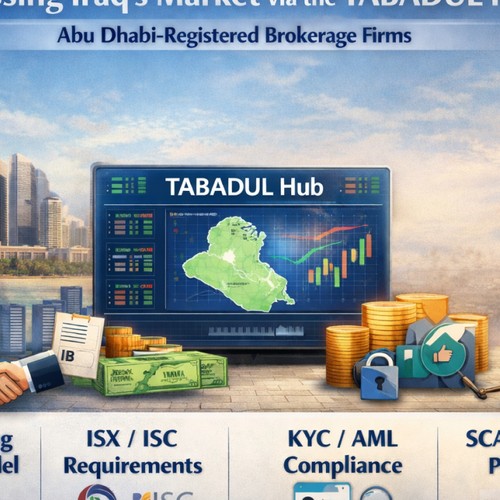
The Iraqi capital market, long viewed as a frontier with significant potential, is progressively opening its doors to international participants. For foreign brokerage firms, particularly those registered and operating out of major financial hubs like Abu Dhabi, a structured pathway now exists to access Iraqi investors and securities. This gateway is facilitated through the TABADUL Exchange Hub, acting as a bridge that connects foreign financial expertise with Iraq’s growing demand for diversified investment services.
This article outlines the legal and procedural framework that enables a foreign brokerage firm, registered with the Abu Dhabi Securities Exchange (ADX) and regulated by the Securities and Commodities Authority (SCA) of the UAE, to extend its brokerage services into the Iraqi market.
1. The Access Model: The “Introducing Broker” Framework
Foreign firms do not obtain a direct, standalone license from the Iraqi Securities Commission (ISC). Instead, they operate under an “Introducing Broker” model, which requires a partnership with the local market infrastructure.
Local Nexus Requirement: The foreign firm must enter into a formal contract with a local, ISC-licensed clearing member within Iraq. This local entity acts as the counterparty for trade settlement and clearing on the Iraq Stock Exchange (ISX).
Role of TABADUL: The TABADUL platform serves as the technological conduit. The foreign firm applies to TABADUL/ISX for permission to use the hub to channel client orders through its local clearing partner for execution on the ISX.
2. Core Eligibility & “Fit and Proper” Requirements
The application process is rigorous, designed to ensure only reputable and well-regulated firms gain access. Key eligibility criteria include:
Home Jurisdiction License: The firm must hold a valid, active brokerage license from its home country regulator (e.g., the UAE’s SCA).
IOSCO Membership: It is highly preferred (and often required) that the firm’s home regulator is a member of the International Organization of Securities Commissions (IOSCO), signifying adherence to international regulatory standards.
Clean Regulatory Record: The firm must certify that its home regulator has not imposed any suspensions or serious disciplinary actions (e.g., for solvency violations) in the six months prior to the application.
“No Objection” Certificate: A formal No-Objection Certificate (NOC) from the home regulator (SCA) is a critical document, confirming the regulator has no objection to the firm operating in the Iraqi market.
3. The Pillars of Compliance: KYC, AML, and Risk Systems
Iraqi authorities place paramount importance on financial integrity and investor protection. The foreign firm must demonstrate robust compliance systems that meet or exceed Iraqi standards.
KYC/AML/CFT Regime: The firm must implement controls for Know Your Customer (KYC), Customer Due Diligence (CDD), and Anti-Money Laundering & Countering the Financing of Terrorism (AML/CFT) that are at least as stringent as those applied in Iraq. Compliance with FATCA and CRS regulations is also explicitly required.
Internal Controls & Risk Management: Submission of the company’s Internal Control System manual and Operational Risk Management manual is mandatory. The ISX and ISC must be satisfied that the firm has adequate systems to monitor market and operational risks.
Technical Approval: The firm’s electronic trading and back-office (“Bank Office”) systems must have prior approval from the relevant regulatory authority in its home country.
4. Investor Onboarding: Rigorous “Know Your Client” (KYC) Procedures
The provided KYC forms reveal a detailed and cautious approach to client acceptance, reflecting a high-risk jurisdiction’s concerns:
Comprehensive Data Collection: Forms require extensive personal, financial, and employment details for natural persons, and full corporate details for legal persons.
Politically Exposed Persons (PEPs) Screening: Explicit questions are asked about relationships with individuals holding senior public office, a key component of AML/CFT protocols.
Dual Commitments: Both the investor and the broker must sign commitments affirming the accuracy of information, verification of documents, and screening against sanctions/PEP lists.
5. Operational & Legal Undertakings
By applying, the foreign firm enters into significant legal undertakings with the ISX:
Transparency & Disclosure: The firm must agree to disclose any material changes in its organizational, financial, or ownership status upon request.
Rule Adherence: It must comply with all ISX rules, ISC regulations, and where applicable, SCA rules.
Limitation of Liability: The firm must acknowledge that the ISX bears no liability for any losses incurred due to platform delays, disconnections, or malfunctions.
Discretionary Power: The ISX reserves the right to reject any application without providing a justification.
Conclusion: A Strategic, Regulated Entry Point
For an Abu Dhabi-based brokerage, the pathway to Iraq via the TABADUL Hub represents a strategic opportunity to tap into a new market while operating within a clear, compliance-focused framework. It is not a simple recognition of a foreign license but a structured approval process that validates the firm’s global standards and integrates it into Iraq’s national market safeguards.
Success hinges on three factors: strong home-regulatory credentials (preferably from an IOSCO member like the SCA), a bullet-proof compliance infrastructure, and a reliable partnership with a local Iraqi clearing member. Firms that navigate this process effectively can position themselves at the forefront of Iraq’s financial market development, offering international brokerage services to a market eager for connectivity and growth.
For further information Contact Us.
Disclaimer: This article is for informational purposes only and does not constitute legal or regulatory advice. Firms should consult with qualified legal counsel.